A delegation led by Professor Emeritus Datuk Dr. Osman Bakar, rector of the International Islamic University Malaysia (IIUM), visited Beijing Foreign Studies University (BFSU) on April 17.
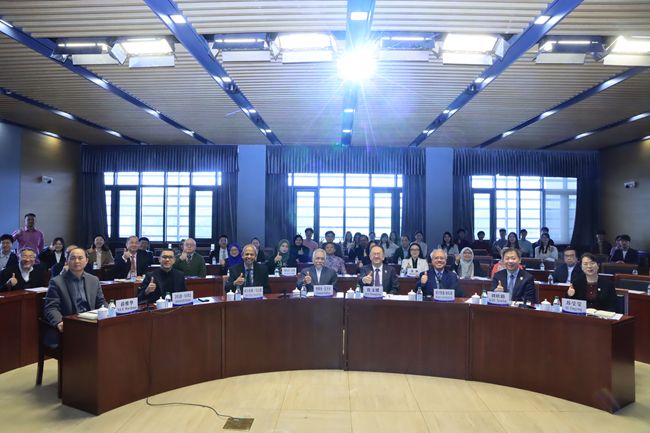
BFSU and IIUM leaders pose for a group photo. [Photo/bfsu.edu.cn]
BFSU President Jia Wenjian welcomed the delegation and highlighted the university's strengths in academic field's development, talent cultivation, scientific research, and international cooperation, particularly in promoting cultural exchanges between China and Malaysia.
Jia emphasized BFSU's commitment to Sino-Malaysian educational cooperation through platforms like the Centre for China-Malay Studies and Confucius Institutes. He proposed three future cooperation directions: innovative educational partnerships to nurture future leaders, high-level research collaborations for joint problem-solving, and youth exchange platforms to foster dialogue and mutual understanding.
Osman Bakar praised BFSU's achievements in Malay language teaching and cultural exchanges between China and Malaysia.
He noted the historical and cultural ties between the two nations and emphasized universities’ crucial role in promoting cross-cultural understanding. He expressed hope for further collaboration in talent cultivation, academic research, and youth exchanges to advance mutual cultural appreciation and development.
Subsequently, Jia Wenjian, along with Dato' Abdul Majit Ahmad Khan, president of the Malaysia-China Friendship Association, formerly Malaysia's ambassador to China, and member of the IIUM Board of Governors, inaugurated the 2026 China-Malaysia Youth Exchange Camp. Scheduled for April 26-30 in Kuala Lumpur, the event is organized by BFSU in collaboration with relevant Malaysian authorities, aiming to provide a platform for youth exchange and deepen bilateral cooperation in culture and education. Twelve Chinese institutions offering Malay language courses will take part in the event.
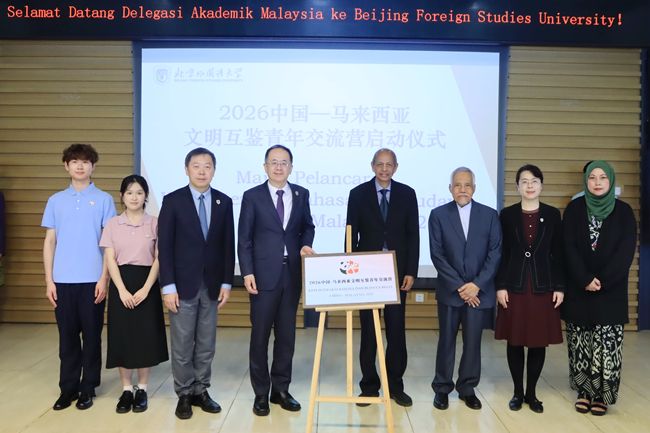
BFSU and IIUM leaders pose for a group photo. [Photo/bfsu.edu.cn]
The delegation also toured the BFSU's History Museum and the Centre for China-Malay Studies to learn about the university's development and achievements in Malay language education.